Thank you very much for visiting Gunter's Space Page. I hope that this site is useful and informative for you.
If you appreciate the information provided on this site, please consider supporting my work by making a simple and secure donation via PayPal. Please help to run the website and keep everything free of charge. Thank you very much.
X-37B OTV 1, ..., 7
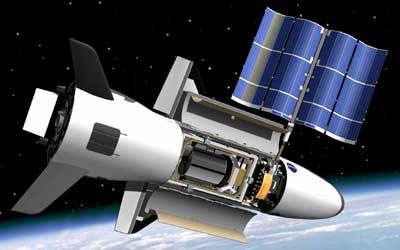
X-37B (on orbit) [Boeing]

X-37B [USAF]

X-37B OTV-2 [USAF]

X-37B OTV-6 with service module [USAF]
The X-37B is a prototype of a reusable uncrewed satellite. The first prototype is for atmospheric testing, while the second has a strengthened structure to support an unshrouded launch, which was originally planned to be launched in the Shuttle payload bay, the transferred after the Columbia accident to a Delta-7920 launch vehicle. Due to problems with the aerodynamics of an unshrouded launch, the first space test was be launched shrouded on a Atlas-5(501) or on a Delta-4M+(5,2) in 2006. Multiple flights with mission durations up to 21 days were planned. NASA asked Boeing to design the X-37 orbital vehicle for a 270-day stay on orbit.
The original X-37 was to feature an AR-2/3 engine for maneuvering and deorbiting, which uses Hydrogen Peroxide and JP-8 as oxidizer and fuel. Later the propulsion system has been changed to a hypergolic nitrogen tetroxide / hydrazine version with a robust propellant load for maneuvering in space and for the deorbit burn.
The X-37's shape is a 120 percent scale derivative of the Air Force's X-40A, also designed and built by Boeing, which was released from a helicopter and glide-tested in 1998. The X-40A, which lacks the X-37's advanced thermal protection materials, rocket engine, experiment bay and other spacecraft systems, was released from a U.S. Army Chinook helicopter in a series of free flight tests in 2001 to reduce technical risk before flight testing the X-37.
NASA has directed Boeing to throttle back on development of the orbital variant of the X-37 prototype space plane until more money is found for the program, an action likely to delay a re-entry and landing demonstration that was planned for 2006.
Following transfer from NASA to DARPA in October 2004, the X-37A technology demonstrator, the Approach and Landing Test Vehicle, recently completed a series of captive carry and free flight tests from the White Knight aircraft, which was also used to launch the SpaceShipOne. The ALTV validated the X-37 program flight dynamics and extended the flight envelope beyond the earlier low speed/low altitude tests conducted by NASA. The ALTV is not capable of space flight.
The OTV program will focus on risk reduction, experimentation, and operational concept development for reusable space vehicle technologies, in support of long term developmental space objectives. The first orbital test flight of the OTV was planned for FY08, with a launch from Cape Canaveral Air Force Station on an Atlas-5(501) launch vehicle. Key objectives of the first flight include demonstration and validation of guidance, navigation and control systems to include fault tolerant, autonomous reentry and landing as well as lightweight high temperature structures and landing gear. Vandenberg Air Force Base will conduct reentry and recovery activities. The first launch did finally take place in 2010.
The first vehicle, X-37B OTV-1 was launched on April 22, 2010 from Cape Canaveral. Although orbital data was classified, the OTV-1 was found in an 401 km × 422 km, 40° orbit by amateur observations. The Centaur upper stage was reportedly disposed of in an escape trajectory to solar orbit. The X-37B OTV-1 conducted several orbit changes during its mission. It landed successfully on December 3, 2010 after 225 days in space. The vehicle was refurbished for a second flight.
The first flight of the second vehicle, X-37B OTV-2, began in March 2011, also on an Atlas-5(501). This time it stayed 469 days in space, more than doubling the endurance of the first mission.
A second flight of the first vehicle, X-37B OTV-3, was launched in December 2012 on an Atlas-5(501). It returned on 17 October 2014 to the Vandenberg AFB after 675 days in space.
A fourth mission, X-37B OTV-4 was launched in 2015 from Cape Canaveral. The individual orbiter used in this mission has not been identified, but is likely the second one. It conducted an Hall thruster electric propulsion experiment to enable in-space characterization of design modifications that are intended to improve performance to the units onboard AEHF military communications spacecraft. Produced by Aerojet Rocktdyne, the AEHF satellites’ Hall thrusters are 4.5-kilowatt units that use electricity and xenon to produce thrust for maneuvering satellites in space. The on-orbit test plans for the experiment were developed by Air Force Research Laboratory and administered by the Rapid Capabilities Office, which runs the X-37B program. The experiment included collection of telemetry from the Hall thruster operating in the space environment as well as measurement of the thrust imparted on the vehicle. Also on board was NASA's METIS (Materials Exposure and Technology Innovation in Space) eperiment to expose nearly 100 different materials samples to the space environment for more than 200 days. METIS is based on the MISSE (Materials on International Space Station Experiment), which flew more than 4,000 samples in space from 2001 to 2013. METIS flew a variety of materials including polymers, composites and coatings. The mission ended after 718 days with a landing at Cape Canaveral AFS on 7 May 2017.
A fifth mission, X-37B OTV-5, was launched in September 2017 from Cape Canaveral on a Falcon-9 v1.2 rocket. The mission carries the Air Force Research Laboratory (AFRL) Advanced Structurally Embedded Thermal Spreader (ASETS-11) to test experimental electronics and oscillating heat pipes in the long duration space environment. The spacecraft remained undetected in orbit for a long time, but was eventually found in a 54.5° orbit at 356 km altitude. It had deployed three small satellites in orbit, which remained unidentified and unregistered until end of the mission. The vehicle returned to earth after 780 days landing at Cape Canaveral AFS on 27 October 2019.
The sixth mission, X-37B OTV-6, is planned for 2020 again on an Atlas-5(501) rocket. Contrary to the earlier mission, a service module, on the aft of the vehicle has been attached for this mission to host more experiments. U.S. Naval Research Laboratory included the PRAM (Photovoltaic Radio-frequency Antenna Module) experiment to transform solar power into radio frequency microwave energy which could then be transmitted to the ground. NASA flies two payloads, a sample plate and space radiation experiments to study the results of radiation and other space effects on a materials sample plate and seeds used to grow food on this mission. This mission did also deploy the FalconSat 8 satellite.
| Nation: | USA |
|---|---|
| Type / Application: | Reusable satellite |
| Operator: | NASA, USAF |
| Contractors: | Boeing |
| Equipment: | ? |
| Configuration: | reusable space plane |
| Propulsion: | R-4D ? |
| Power: | Deployable solar array, batteries |
| Lifetime: | 270 days (nominal); 225 days (#1); 469 days (#2); 675 days (#3) |
| Mass: | 5400 kg |
| Orbit: | 401 km × 422 km, 40° (#1), 315 km × 341 km, 43° (#2), 343 km × 360 km, 43.5° (#3); 312 km × 325 km, 38° (#4); 355 km × 356 km, 54.5° (#5); 323 km × 38838 km, 59.1° (#7) |
| Satellite | COSPAR | Date | LS | Launch Vehicle | Remarks | |
|---|---|---|---|---|---|---|
| X-37B OTV-1 (X-37B #1 F1, USA 212) | 2010-015A | 22.04.2010 | CC SLC-41 | Atlas-5(501) | ||
| X-37B OTV-2 (X-37B #2 F1, USA 226) | 2011-010A | 05.03.2011 | CC SLC-41 | Atlas-5(501) | ||
| X-37B OTV-3 (X-37B #1 F2, USA 240) | 2012-071A | 11.12.2012 | CC SLC-41 | Atlas-5(501) | ||
| X-37B OTV-4 (X-37B #2 F2, USA 261) | 2015-025A | 20.05.2015 | CC SLC-41 | Atlas-5(501) | with GEARRS 2, LightSail 1, OptiCube 1, OptiCube 2, OptiCube 3, USS Langley, AeroCube 8A, AeroCube 8B, BRICSat-P, PSat A | |
| X-37B OTV-5 (X-37B #2 F3, USA 277) | 2017-052A | 07.09.2017 | CCK LC-39A | Falcon-9 v1.2 | with USA 295, USA 296, USA 297 | |
| X-37B OTV-6 (X-37B #1 F3, USA 299, USSF 7) | 2020-029A | 17.05.2020 | CC SLC-41 | Atlas-5(501) | with FalconSat 8 | |
| X-37B OTV-7 (X-37B #2 F4, USA 349, USSF 52) | 2023-210A | 29.12.2023 | CCK LC-39A | Falcon-Heavy (Block 5)(px) |
References:
- US Air Force: Air Force advances space vehicle development
- Wright-Patterson Air Force Base: AFRL thruster experiment to fly on X-37B, 27 April 2015
- NASA: NASA Test Materials to Fly on Air Force Space Plane, 6 May 2015